My research examines how algorithms shape people’s experiences online and how media producers think about algorithms in their creative decision-making. I primarily employ qualitative methods to answer these questions, providing in-depth insights into how and why people and media function in specific ways.
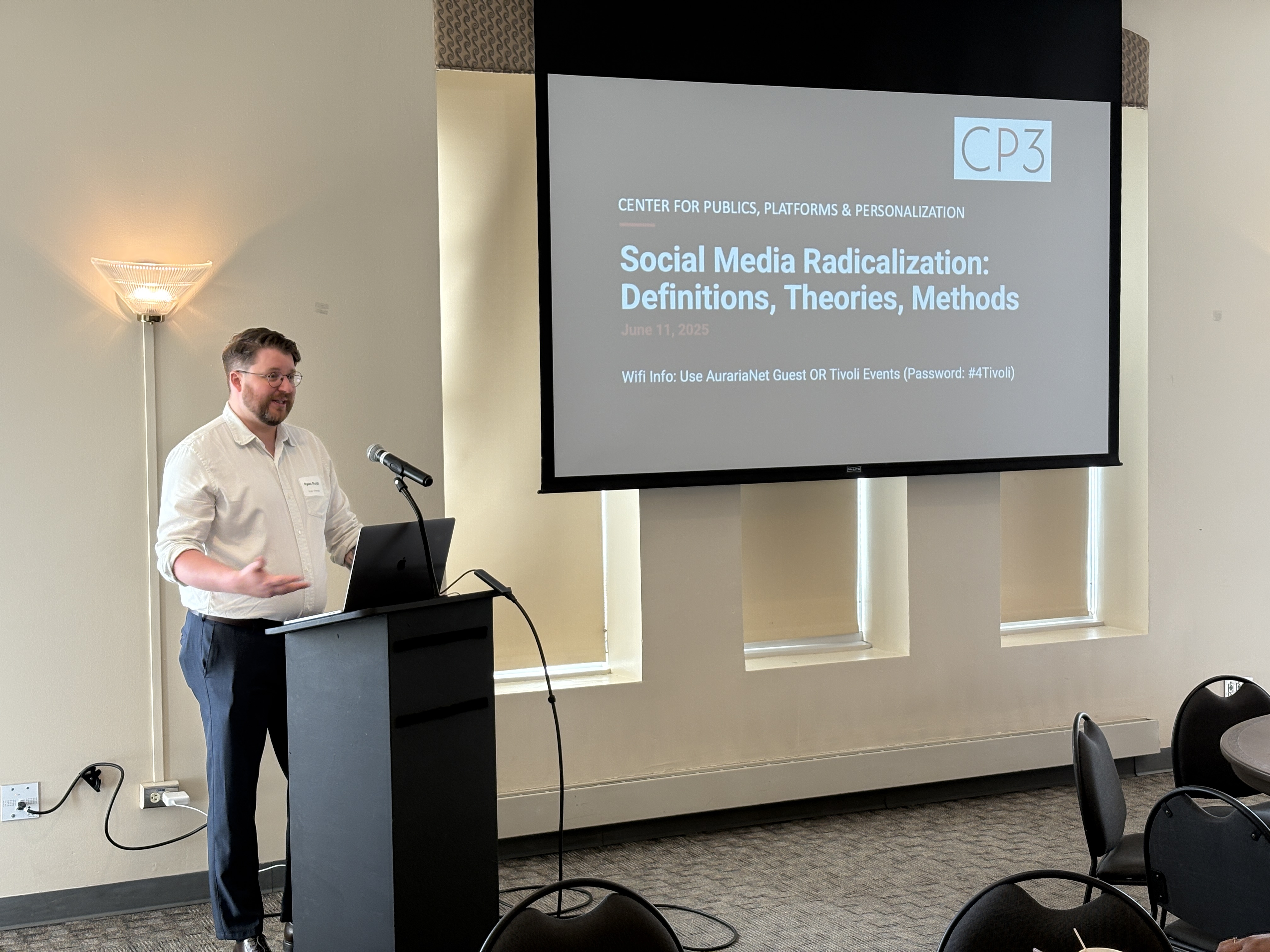
I am a research affiliate at the Center for Publics, Platforms, & Personalization (CP3), so a significant portion of my more recent research has examined how personalization algorithms relate to sociopolitical radicalization and are affected by strategic information campaigns.
My research has been published in a number of flagship media and communication journals, and you can find a full listing of my research on Google Scholar.
Radicalization Online
This work examines the relationship between sociopolitical radicalization and the Internet, focusing primarily on algorithms and how people respond to them. It was funded by a three-year grant from the United States Department of Defense’s Minerva Research Initiative.
“They’re Trying to Influence Me to Gain the More Acceptable Viewpoint:” The Algorithmic Imaginaries of Politically Activated Social Media Users (2025) by Raven Maragh-Lloyd, Ryan Stoldt, Javie Ssozi, Katy Biddle, Brian Ekdale, and Tim Havens in New Media & Society
- PDF: https://journals.sagepub.com/doi/pdf/10.1177/14614448251338502
- Abstract: Links between extremism online and personalization algorithms are, by now, widely accepted. However, discussions surrounding sociopolitical radicalization and its relationship to filter bubbles often fail to account for user agency. Based on interview (N = 29) and survey (N = 1100) data, our study asks how politically engaged social media users make sense of algorithmic personalization related to political topics of interest. Our results indicate that most respondents conceptualize personalization as a functional process of social media platforms seeking to deliver relevant information, while a small but vocal number of users claim algorithms are designed not to personalize content but rather to enact an ideological agenda. Our findings, which include real-time user responses to algorithms, suggest that algorithms do not simply radicalize unsuspecting users but, rather, are negotiated to reveal a more complex digital landscape.
Beyond “Lulz” and “Keyboard Warriors:” (2024) by Katy Biddle, Brian Ekdale, Andrew High, Ryan Stoldt, and Raven Maragh-Lloyd in Information, Communication, & Society
- PDF: https://www.tandfonline.com/doi/pdf/10.1080/1369118X.2024.2302988
- Abstract: Despite the similar psychological profiles of internet trolls and radicalized political actors, as well as the historical connections between trolling and the alt-right, little research has studied how trolling corresponds with the process of radicalization. Our study examines this relationship between trolling and radicalization by interrogating two pieces of folk wisdom about internet trolls, that they only care about ‘the lulz’ and that they are merely ‘keyboard warriors.’ Using the issue of racial inequality in the United States as a case study, we ask whether someone’s enjoyment of trolling is affected by their attitudes about racial inequality as well as whether those who enjoy trolling are more likely to engage in politically motivated activist and radical activities related to their views about race. Based on a nationally representative survey (N = 739), our study finds that those who enjoy the discursive act of trolling also intend to participate in other forms of political engagement, including both activist and radical activities. Overall, our findings reveal significant overlaps between trolling, activism, and radical activities when it comes to the topic of racial inequality, demonstrating the value of considering discursive acts like trolling within the broader context of studying the adoption of extremist ideologies and actions.
Algorithms & Society
This work examines how the algorithmic distribution of content affects what information people find online and how they find it.
Searching for Information: How Partisan Audiences on Google Search Induce an Abortion-Related Filter Bubble Effect (2025) by Hussam Habib, Ryan Stoldt, Andy High, Brian Ekdale, Ashley Peterson, Katy Biddle, Javie Ssozi, and Rishab Nithyanand in the Proceedings of the ACM on Human-Computer Interaction
- PDF: https://dl.acm.org/doi/epdf/10.1145/3757656
- Abstract: The evolution of information-seeking processes, driven by search engines like Google, has reshaped how people access and interact with information. This paper examines how individuals’ pre-existing attitudes on polarizing topics, such as the legality of abortion, influence their engagement with modern information-seeking processes. Recruiting participants from an undergraduate population of a university we use a mixed-methods study involving surveys and information-seeking tasks focused on the legality of abortion, this work offers five key insights. First, individuals with opposing abortion-related attitudes receive different search results. Second, the vocabulary used when formulated search queries differs significantly across opposing attitudes. Third, this difference in query vocabulary has a significant effect on the search results. Fourth, this effect remains consistent, though reduced, when personalization is removed from the process. Finally, Google Search returns search results that align with users’ pre-existing attitudes, thereby reinforcing those attitudes. Taken together, these findings reveal a critical relationship between human biases, partisan audiences, and algorithmic processes. Specifically, our findings underscore how search platforms such as Google Search, which play a crucial role in the modern information-seeking process, contribute to information polarization.
Using Racial Discourse Communities to Audit Personalization Algorithms (2023) by Ryan Stoldt, Raven Maragh-Lloyd, Tim Havens, Brian Ekdale, and Andy High in Communication, Culture, & Critique
- PDF: https://watermark02.silverchair.com/tcad015.pdf
- Abstract: Personalization algorithms are the information undercurrent of the digital age. They learn users’ behaviors and tailor content to individual interests and predicted tastes. These algorithms, in turn, categorize and represent these users back to society—culturally, politically, and racially. Researchers audit personalization algorithms to critique the ways bias is perpetuated within these systems. Yet, research examining the relationship between personalization algorithms and racial bias has not yet contended with the complexities of conceptualizing race. This article argues for the use of racialized discourse communities within algorithm audits, providing a way to audit algorithms that accounts for both the historical and cultural influences of race and its measurement online.
Trust in Online Search Results During Uncertain Times (2022) by Ashley Peterson, Andy High, Raven Maragh-Lloyd, Ryan Stoldt, and Brian Ekdale in the Journal of Broadcasting & Electronic Media
- PDF: https://www.tandfonline.com/doi/pdf/10.1080/08838151.2022.2141242
- Abstract: Drawing from the layer model of trust, this study examines what factors influence the perceived quality of search results. Participants (N = 256) conducted searches about current events and evaluated the quality of the results they received along with their trust in technology and attitudes toward the search topic. Consistent with the layer model of trust, people’s propensity to trust technology corresponded with greater perceptions of search quality, though the effect through people’s belief in Google’s search algorithm was stronger. Overall, increasingly specific assessments of layers of technology help explain why people evaluate search results to vary in quality.
Media Production
This work examines how media producers make decisions, paying particular attention to their ethical and normative choices.
Ethics of Authenticity: Social Media Influencers and the Production of Sponsored Content (2020) by Mariah Wellman, Ryan Stoldt, Melissa Tully, and Brian Ekdale
- PDF: https://d1wqtxts1xzle7.cloudfront.net/101265113/23736992.2020.173607820230419-1-q89bwc-libre.pdf
- Abstract: Media coverage of influencer marketing abounds with ethical questions about this emerging industry. Much of this coverage assumes influencers operate without an ethical framework and many social media personalities skirt around the edges of legal guidelines. Our study starts from the premise that influencer marketing is not inherently unethical but, rather, the ethical principles guiding production of sponsored content are not well understood. Through a case study of the travel and tourism media industry, our findings demonstrate that influencers use the concept of authenticity as an ethical framework when producing sponsored content. This ethics of authenticity is premised on two central tenets: being true to one’s self and brand and being true to one’s audience. This framework puts the influencers’ brand identity and relationship with their audience at the forefront while simultaneously allowing them to profit from content designed to benefit brands and destinations.
Professionalizing and Profiting: The Rise of Intermediaries in the Social Media Influencer Industry (2019) by Ryan Stoldt, Mariah Wellman, Brian Ekdale, and Melissa Tully
- PDF: https://journals.sagepub.com/doi/epub/10.1177/2056305119832587
- Abstract: This study examines the relationship between travel influencers (e.g., bloggers and social media personalities) and destination marketers within the changing travel and tourism industry. Through in-depth interviews, observations, and document analysis, we explore the tensions between travel influencers and destination marketers that shape the way travel is promoted, labor is compensated, and professional structures are negotiated. We examine a new breed of travel and tourism worker—intermediaries who seek to professionalize and formalize the relationship between influencers and destination marketers while simultaneously solidifying their own role within the industry. Intermediaries promote and facilitate relationships based on structured flexibility—formalized agreements designed to satisfy a brand’s campaign goals yet open enough for influencers to pursue their unique needs. By examining the relationships between digital content creators, destination marketers, and third-party intermediaries, this article provides insight into how digital media industries negotiate the tension between participation and control.

